
Shock Tools are designed to isolate the drill string from axial deflections produced by the bit during drilling operations. This reduces impact loading on the bit and drill string and increases penetration rates by keeping the bit on bottom during rough drilling conditions and reduces bit trips.
Constant load/deflection characteristics are maintained regardless of hole depth, bit weight, pump pressure, mud weight or torque. Free vertical movement is assured by guiding the mandrel in the barrel above and below the spline drive to prevent lateral loads from acting on the drive assembly. Griffith Shock Tools are sprung in both directions to compensate for pump open forces.
By isolating axial bit vibrations from the drill string, the shock tool will reduce axial, lateral and torsional drill string vibrations, and related fatigue damage or failure of the rotary connections
Shock Tool contains a chamber and piston to compensate for lubricant expansion at higher operating temperatures.Larger diameter (11" to 14") tools are designed with a pressure compensation system to reduce the excessive pump open effect inherent in larger diameter tools. This design permits a relatively low spring rate, desirable when drilling large diameter holes, without fully extending the tool at high pump pressure. 14" Shock Tools are available with an optional reamer sub for 17-1/2" hole size.
 Will not build angle, as it is well stabilized between barrel and mandrel. Reduces bit bounce and extends bit life by reducing impact loads on teeth and bearings. Effectively reduces impact loading to extend bit life. Isolates bit induced vibrations from the drill string. Fully oil‐sealed and lubricated for extended service life. Pressure balanced to eliminate the effect of downhole hydrostatic pressure. Automatically compensates for pump open force. Low friction torsional drive permits free vertical movement. Well‐stabilized, with internal lateral support to minimize deflection. Reduces wear and tear on rig and equipment, and fatigue failures on drill collars and drill pipe. Reduces drill string vibration and impact from MWD systems. Can be provided in both near bit and string applications.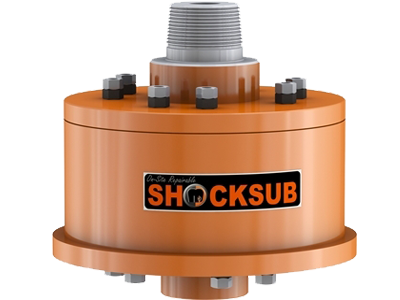
The Shock Sub impact and vibration reduction sub is a drill string component that absorbs and dampens the variable axial dynamic loads produced by the drill bit during routine drilling. It is most beneficial when drilling in hard rock, broken formations, and intermittent hard and soft streaks. Reducing the impact loads helps to increase ROP; improve borehole quality; and extend the life of the cutting structure, bearings, connections, and surface equipment—all translating to a lower cost of drilling per foot. If the Shock Tool is located above the packed bottom‐hole assembly, a minimum of two drill collars should be placed between the top stabilizer and Shock Tool to minimize bending stresses in the Shock Tool and provide a clear target for a string shot if required. Avoid locating the shock tool at a cross over between components of different diameters such as drill collars and heavy weight drill pipe. The shock tool should be placed a minimum of two joints above or below any cross over.
The Shock Sub impact and vibration reduction sub does not need to be activated in order to operate. During the drilling it is constantly working. As the cones of a roller cone bit traverse the pattern of “peaks and valleys” created on the bottom of the borehole, the spring assembly in the sub is compressed or allowed to relax, absorbing the shock load. Additionally, the load is dissipated by the mechanical friction resulting from the movement of the spring stack.
The axial movement of a hammer bit produces a similar compression and extension of the springs. These two combined actions isolate the axial loads present during the drilling operation and maintain a near constant WOB when the sub is run within its operational load limits.


